Best Wireless Earbuds for Android (2026)
The Short Version
- Best overall: the Sony WF-1000XM6 ($329.99) — LDAC support, the strongest noise cancelling in this group per SoundGuys' measurements, and battery that beat Sony's own rating in independent testing. Skip it if you have small ears; the new housing is bigger.
- Don't buy on brand, buy on phone. Samsung's hi-res Seamless Codec only works on Galaxy devices, and hands-free Gemini is a Pixel Buds thing. If you own a Galaxy S26, the Galaxy Buds4 Pro ($249) unlock features nothing else can. If you own a Pixel, the Pixel Buds Pro 2 do the same.
- You do not need to spend $300 to get LDAC. The Soundcore Liberty 4 NC lists around $79 and has been discounted to $59.99 — the cheapest credible route to hi-res audio on Android. Its ANC is not flagship-grade no matter what the box says.
- Best cheap pick with real Google integration: the Pixel Buds 2a ($129 list, seen as low as $99) inherit the Tensor A1 chip and hands-free Gemini from the Pro 2.
Most earbud roundups are written as if the phone in your pocket doesn't matter. On Android it matters enormously — arguably more than the drivers do. Android is the only major mobile platform that carries LDAC, Sony's hi-res Bluetooth codec, and it's the only one where a manufacturer can bolt a proprietary codec onto its own handsets and lock the good version of the audio behind them. That's the whole reason this guide exists.
Three Android-specific things decide whether a set of earbuds is a good buy for you, and none of them show up in a generic "best earbuds" list:
Codec support. LDAC transmits substantially more data than AAC, which is the ceiling you get on iOS. On Android, LDAC is a genuine platform advantage, and it's now available at every price tier from $59.99 up. Ecosystem lock-in. Samsung's hi-res Seamless Codec works only on Galaxy devices; hands-free Gemini is a Pixel Buds feature. Buy the wrong pair for your phone and you've paid for a headline feature you will never once use. Fast Pair and multipoint. Fast Pair is the Android equivalent of Apple's instant-pairing popup and is broadly standard on these picks; multipoint — holding two devices at once, phone and laptop — is the one to actually check on the spec sheet, because it's still not universal.
How We Evaluate Earbuds for Android
Loiter Point does not run a test lab. We don't own an anechoic chamber, a head-and-torso simulator, or a bank of battery loggers, and we're not going to pretend otherwise so a review reads more authoritatively. What we do is narrower and, we'd argue, more useful: we synthesize published independent measurements from outlets that do own that equipment — SoundGuys and Consumer Reports are the two we lean on most heavily here — and we cross-check those numbers against owner reports and long-term reviewer commentary.
Three rules govern how figures appear on this page. First, every real-world number is attributed to whoever produced it. Second, manufacturer specs are labeled as manufacturer specs and are never presented as independently confirmed — that distinction matters a lot in the ANC marketing numbers below. Third, where the evidence is thin or the sources disagree, we say so rather than papering over it with confident prose. There are places on this page where the honest answer is "nobody has published a good measurement of that," and you'll see us write exactly that.
Prices move constantly, especially on the Google and Soundcore picks. Treat every price here as a snapshot at the time of writing, not a promise.
The Five Picks
 Click to zoom
Sony WF-1000XM6
The best-measuring noise cancelling in this group, the longest independently verified battery life, and LDAC — but the new housing is physically larger, and the upgrade over the XM5 is narrow.
What's good
- SoundGuys measured roughly 88% average noise reduction — the strongest number in this roundup.
- Independent testing recorded 9 hours 41 minutes on one charge, beating Sony's own 8-hour claim. That's rare; most products go the other way.
- LDAC plus a 10-band EQ makes this the most tweakable serious option for Android.
- Reviewers repeatedly single out mic quality via the AI beamforming array.
What's not
- The redesigned housing is bigger. Multiple reviewers flag that it may not suit smaller ears — try before you commit if you can.
- At $329.99 you're paying flagship money for focused upgrades. Battery rating and codec support are unchanged from the XM5.
- IPX4 only — fine for sweat and drizzle, not for anything more.
 Click to zoom
Samsung Galaxy Buds4 Pro
A genuine dual-driver design and a hi-res codec that works on exactly one brand of phone. If you don't own a Galaxy, this is the wrong purchase — and that's not a criticism of the hardware.
What's good
- SoundGuys found it blocks about 84% of outside noise at full strength — a clear improvement on the Buds3 Pro.
- IP57 is the toughest rating in this group by a wide margin.
- Consumer Reports rates the sound "very good" and the active noise reduction "very good."
- Two-driver setup plus Live Translation and deep Galaxy integration you genuinely can't replicate elsewhere.
What's not
- The Seamless Codec is the headline feature and it is hard-locked to Galaxy hardware. On any other Android phone you're buying a $249 pair of AAC earbuds.
- Still behind the XM6 in SoundGuys' isolation measurements (~84% vs ~88%).
- Consumer Reports notes some noticeable sonic quirks alongside the positive rating.
- ~6h with ANC on is the shortest single-charge figure among our flagship picks.
 Click to zoom
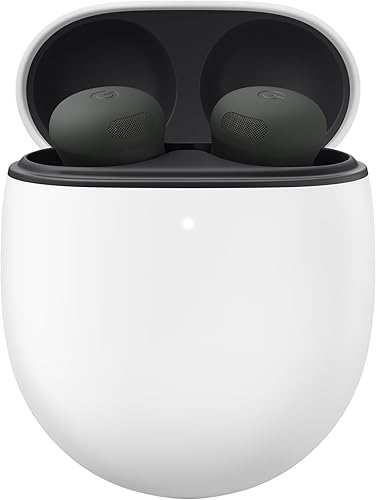
Google Pixel Buds Pro 2
Isolation within a few points of the class leader for a street price around half the XM6, plus the best hands-free assistant implementation on Android. The discounting is the real story here.
What's good
- SoundGuys frames it as letting through about four percentage points more outside noise than the XM6 — a gap small enough that most listeners won't notice it. Still top-tier isolation.
- Confirmed Bluetooth multipoint, which not every competitor at this price guarantees.
- Hands-free Gemini is the most seamless assistant experience of anything here.
- Street pricing has been aggressive: around $169, as low as $165, and open-box units at $131.99.
What's not
- We can't verify codec support beyond the basics, so we're not going to claim any. If hi-res on Android is your priority, the XM6 or Liberty 4 NC are the documented choices.
- Gemini integration is the selling point, and it's most valuable on a Pixel. On a Galaxy you're leaving some of the value on the table.
- Still the current Pro model as of July 2026 — no newer Pro has launched this year — which is good for confidence and bad if you're allergic to buying near the end of a cycle.
 Click to zoom
Google Pixel Buds 2a
The first A-series Pixel Buds with ANC, running the same Tensor A1 chip as the Pro 2. Excellent sound for the money; the noise cancelling is where the cost came out.
What's good
- Reviewers put sound quality among the best in its price range.
- 7h with ANC on is longer than the Galaxy Buds4 Pro managed in independent testing, at roughly half the price.
- Hands-free Gemini and the Tensor A1 chip carried down from a $229 product.
What's not
- ANC handles steady low-frequency noise — HVAC hum, train rumble, plane cabin — well, but is clearly behind both Pixel Buds Pro and Pro 2, especially with dynamic or changing noise.
- Android Central characterized them as heavy on bass and light on features. If you want granular EQ and every toggle, look up the range.
- As with the Pro 2, we're not making codec claims we can't source.
 Click to zoom
Soundcore Liberty 4 NC
LDAC and 50 hours of total battery for under a hundred dollars. Ignore the ANC marketing number entirely and this is the best value on the page.
What's good
- LDAC at roughly a quarter of the XM6's price — the cheapest documented route to hi-res audio on Android in this group.
- 50h total battery with the case, plus wireless charging, at a price where wireless charging usually disappears.
- At the $59.99 sale price this is a genuinely hard product to argue against.
What's not
- The "98.5% noise reduction / 43 dB adaptive ANC" figure is Anker's own marketing claim, not an independent measurement. Independent measurements of budget ANC in this class generally land lower. Do not buy this expecting XM6-tier isolation.
- Bluetooth 5.3 and IPX4 — fine, not leading.
- No ecosystem integration to speak of. It's a good pair of earbuds, not a companion device.
Nerd box: what LDAC actually costs you
LDAC is the single best reason to buy earbuds specifically as an Android user. It transmits substantially more data than AAC, and on iOS you simply fall back to AAC — so this is a real platform advantage, not a spec-sheet curiosity. But it is not free, and the industry is quiet about the bill.
The clearest public evidence comes from the Nothing Ear (3) ($179, LDAC and LHDC 5.0, Bluetooth 5.4). Its rated battery with LDAC is 5.5 hours with ANC off and 3.5 hours with ANC on — and reviewers reported buds dying at around three hours with ANC on and LDAC enabled. That is a dramatic haircut versus what you'd expect from the same hardware on AAC, and it's the honest counterweight to every "supports hi-res!" bullet point, including the ones on this page.
Two more things worth internalizing. LDAC negotiates its bitrate adaptively and will drop to lower rates in RF-congested environments — a packed train car, an office full of access points. The headline bitrate is a ceiling, not a guarantee, and you often won't be told when you've fallen off it. And published per-bitrate battery figures are genuinely scarce across the entire industry; almost nobody rates endurance separately for LDAC versus AAC, which makes cross-shopping on this dimension harder than it should be. If you want LDAC cheaply to try it out, the Liberty 4 NC or the Nothing Ear (3a) — launched around July 2026 at $99 with LDAC — are the low-risk entry points.
Head-to-Head Comparison
| Model | Price | Hi-res codec | Battery (ANC on) | Noise reduction | Water | Best for |
|---|---|---|---|---|---|---|
| Sony WF-1000XM6 | $329.99 | LDAC | 8h rated; 9h 41m reported by SoundGuys | ~88% avg (SoundGuys) | IPX4 | Any Android phone; best isolation |
| Samsung Galaxy Buds4 Pro | $249 | Seamless Codec — Galaxy only | ~6h, est. real-world (independent labs) | ~84% (SoundGuys) | IP57 | Galaxy S26 and other Galaxy owners |
| Google Pixel Buds Pro 2 | $229 list / ~$169 street | Not verified — no claim made | Up to 8h rated | ~4pp behind XM6 (SoundGuys) | IP54 | Pixel owners; Gemini; multipoint |
| Google Pixel Buds 2a | $129 list | Not verified — no claim made | 7h rated (10h ANC off) | Reported good on steady noise, weak on dynamic | — | Budget buyers who want Gemini |
| Soundcore Liberty 4 NC | ~$79 (seen at $59.99) | LDAC | 50h total with case (rated) | 98.5% — Anker marketing claim, unverified | IPX4 | Cheapest credible LDAC |
Blank cells and "not verified" entries are deliberate. Where we couldn't source a figure from an independent measurement or a manufacturer spec we trust, we left it out rather than filling the grid.
Bottom Line
If your phone is a Pixel, buy the Pixel Buds Pro 2 when they're near their $165–$169 street price. You give up roughly four percentage points of noise reduction against the class leader — a gap SoundGuys' own framing suggests most people won't notice — and you save well over a hundred dollars while getting multipoint and the assistant integration Google built for its own hardware.
If your phone is a Galaxy, the Galaxy Buds4 Pro are the only way to get the Seamless Codec, and the IP57 rating and dual-driver design stand on their own. Just be clear-eyed that you're buying into lock-in: those features evaporate the day you switch brands. If you're not sure you'll still be on Galaxy in two years, that changes the math.
If you want the best thing regardless of which Android phone you carry, it's the Sony WF-1000XM6. The best isolation figure SoundGuys recorded in this group, LDAC, a battery result that beat the manufacturer's own rating in independent testing, and a 10-band EQ. Two honest caveats: the housing got bigger and may not fit smaller ears, and at $329.99 the upgrade over the XM5 is focused rather than sweeping — battery rating and codec support didn't change.
And if the whole point is hi-res audio without flagship pricing, the Soundcore Liberty 4 NC gets you LDAC for around $79 — less on sale. Buy it for the codec and the 50-hour case, not for the 98.5% number on the packaging, which is Anker's claim and not something any independent lab has confirmed. Budget-conscious Google fans should take the Pixel Buds 2a instead: better ecosystem fit, real Gemini support, and ANC that's fine on plane and train drone but noticeably behind the Pro models when the noise around you keeps changing.
Whichever way you go, check multipoint before you buy if you split time between a phone and a laptop, and remember the nerd box: turning on LDAC will cost you battery, sometimes a lot of it, and nobody in this industry publishes good per-codec endurance numbers. That's an open gap in the public evidence, not something we're going to fill in with a guess.