The Best Portable Power Stations of 2026
A portable power station is a battery, an inverter, and a fistful of outlets in a box you can carry. The good ones keep a fridge cold through a blackout or run a CPAP for two nights off-grid; the bad ones sag under load and lie about their capacity. We ranked the class of 2026 on the three things that actually matter — usable capacity, recharge speed, and cost per watt-hour — and cut the rest.
The Short Version
- Best for most people: the Anker SOLIX C1000 — 1,056Wh, 1,800W, and a genuinely sub-hour recharge. It covers blackouts and camping without overthinking it.
- Best value: the Bluetti AC70 — the lowest cost per watt-hour here and light enough to carry one-handed.
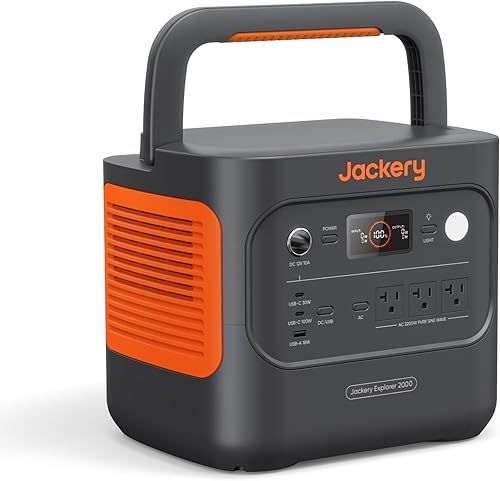
- Best big-battery backup: the Jackery Explorer 2000 v2 — 2,042Wh at a remarkable 39.5 lb.
- Best grab-and-go: the EcoFlow River 3 Plus — 10.4 lb, expandable, and fast to refill.
How We Evaluate Portable Power Stations
Loiter Point does not run a battery lab, and we won't pretend otherwise. What we do is read the people who do — independent testing outfits like OutdoorGearLab that measure real run-times and recharge curves on a bench — and cross-check their numbers against a large pile of verified owner reports for the failure modes that only show up after a year of use: fans that never shut off, apps that drop Bluetooth, capacity that fades faster than the spec sheet implies.
Three metrics drive the ranking. Usable capacity matters more than the rated watt-hours printed on the box, because inverter and conversion losses mean you never get all of it to your devices — independent tests typically find roughly 85% of a station's rated capacity actually reaches an AC load. Recharge speed decides whether the thing is useful in a rolling blackout or a short solar window. And cost per watt-hour is the honest way to compare a $299 unit against a $1,199 one. Battery chemistry is the tiebreaker: we favor LiFePO4 (LFP) cells, which independent testing and manufacturer ratings both put at 3,000-plus cycles — several times the lifespan of the older NMC lithium chemistry.
 Click to zoom
The one that covers 90% of buyers
The C1000 is the default answer because it does everything a mid-size station should and skips the compromises. It's 1,056Wh of LiFePO4 behind an 1,800W inverter — enough to run a full-size fridge, a couple of laptops, and phone charging through an outage — and Anker rates a full recharge at 58 minutes, which independent reviewers have confirmed lands under the hour with the fast-charge mode on. A 2,400W surge handles the startup spike on most household motors.
 Click to zoom
Lowest cost per watt-hour in the group
If you want the most battery per dollar, the AC70 is it. At 768Wh and 22.5 lb it's the easiest unit here to actually pick up and move, and its 1,000W inverter "power-lifts" to a claimed 2,000W to start heftier loads for short bursts. One independent reviewer scored it 8.4/10 after roughly a month of use with no faults. It's not the fastest to recharge and the 768Wh ceiling is modest, but for car camping, a home office UPS, or a first station, the math is hard to beat.
 Click to zoom
Two kilowatt-hours you can still carry
The headline is the weight: 2,042Wh in a 39.5-lb package, which Jackery pegs at roughly 41% lighter and 34% smaller than a typical 2kWh LiFePO4 station. That's the difference between a two-person lift and a one-person carry. A 2,200W inverter runs most of a household's essentials at once, and 100W USB-C PD tops off laptops fast. Jackery moved this generation to LiFePO4, so cycle life is finally in the same league as its rivals — a real upgrade over the NMC cells in some older Jackery flagships. This is the pick when a 1kWh unit simply isn't enough runway.
The one that refills before you finish coffee
The Delta 2 is the veteran of this list and still the one to beat on charging and ecosystem. EcoFlow rates 0–80% in about 50 minutes and a full charge in roughly 80 from a wall outlet, and its app is widely regarded as the best in the category for real-time monitoring. The base 1,024Wh unit bolts on to a smart extra battery to expand capacity when you need more, and it carries a strong verified-buyer track record on Amazon (4.7/5 across thousands of ratings). If you value fast turnaround and room to grow over raw portability, start here.
 Click to zoom
The 10-pound one that lives in your trunk
Not everyone needs a kilowatt-hour brick. The River 3 Plus is 286Wh and 10.4 lb — a one-hand carry that still pushes 600W (1,200W with X-Boost) across three AC outlets, and it runs near-silent under 30 dB. Two features punch above the price: a sub-10ms UPS switchover that makes it a legitimate desktop battery backup, and expandability to 858Wh with add-on packs if your needs grow. For phones, laptops, a CPAP, or a router-and-modem outage kit, it's the sensible entry point.
A station labeled 1,000Wh will never hand a 1,000Wh AC load to your devices. Two taxes eat the difference. First, the inverter that turns the battery's DC into household AC runs at roughly 85–90% efficiency, and that loss becomes heat. Second, most quality LiFePO4 packs reserve a sliver of capacity at the top and bottom of the charge window to protect cell health. Net effect: plan on about 85% of the rated number reaching your gear — so a 1,056Wh Anker C1000 realistically delivers something like 900Wh of usable AC energy. It's why we list an "est. real-world" row on every card and treat the sticker figure as a ceiling, not a promise. Cold weather widens the gap further; lithium cells give up capacity below freezing.
How the Picks Compare
| Model | Rated Wh | AC output | Weight | Street price | Best for |
|---|---|---|---|---|---|
| Anker SOLIX C1000 | 1,056Wh | 1,800W / 2,400W | 24.9 lb | ~$499–799 | Most people |
| Bluetti AC70 | 768Wh | 1,000W / 2,000W | 22.5 lb | ~$399–599 | Value / first station |
| Jackery Explorer 2000 v2 | 2,042Wh | 2,200W | 39.5 lb | ~$999–1,199 | Whole-house backup |
| EcoFlow Delta 2 | 1,024Wh | 1,800W / 2,700W | ~27 lb | ~$599–999 | Fast charge / expand |
| EcoFlow River 3 Plus | 286Wh | 600W / 1,200W | 10.4 lb | ~$269–299 | Compact / UPS |
Prices swing hard on these — power stations are among the most heavily discounted categories on Amazon, and every model here has sold for meaningfully less than MSRP during major sale windows. If you're not in a rush, watching a price tracker for a few weeks routinely saves $100–300.
How to Size One for Your Actual Needs
Work backwards from watt-hours, not marketing tiers. Add up the wattage of what you'll run and multiply by hours: a 60W CPAP for two 8-hour nights is roughly 960Wh, which pushes you past the AC70 into C1000/Delta 2 territory. A weekend of phones, a laptop, and some LED lights is a couple hundred watt-hours — River 3 Plus range. And check the continuous AC rating against your highest single load: a 1,500W space heater or microwave needs a 1,800W-plus inverter, which rules the smaller units out no matter how much battery they hold. When capacity and inverter are both borderline, size up; a station running near its limit gets hot, loud, and short-lived.
The Bottom Line
For most buyers the Anker SOLIX C1000 is the right amount of everything — capacity, output, and a recharge fast enough to matter — at a price that regularly dips under $500. Tight budget or first-timer: the Bluetti AC70 gives up the least per dollar. Need to backstop a whole household and still carry it solo, the Jackery Explorer 2000 v2 is the standout. Want the fastest refills and room to grow, take the EcoFlow Delta 2. And if you just want a reliable 10-pound safety net, the EcoFlow River 3 Plus is the easy yes. All five run LiFePO4 chemistry, so whichever you pick should still be holding a useful charge years from now.
Pair any of these with the right recharge kit — see our companion guide to the best power banks for topping off phones on the trail, and our best portable air conditioners roundup if summer off-grid comfort is the goal.