The Best Smart Bulbs of 2026
Updated July 2026 · Evidence-first, no lab fluff
Smart bulbs have quietly split into two camps: premium hub-based systems that never drop off your network, and cheap Wi-Fi bulbs that do almost everything for a quarter of the price. The right pick depends less on brightness and more on how many bulbs you plan to run and which voice assistant you already live in. Below are five bulbs worth buying in 2026, drawn from published independent testing and a wide read of verified owner reports — not a lab we don't have.
The Short Version
- Best overall (whole-home): Philips Hue White & Color Ambiance — the most reliable, most automatable system if you're lighting a whole house and don't mind the Bridge.
- Brightest, no hub: LIFX Color A19 — 1100 lumens and the punchiest color, straight over your Wi-Fi with no bridge to buy.
- Best value: WiZ Color A19 (Matter) — roughly $8 a bulb, Matter-ready, and it just works on Alexa or Google.
- Most effects per dollar: Govee Smart Bulbs — music sync and dozens of scenes for party-room duty on the cheap.
How We Evaluate Smart Bulbs
Loiter Point doesn't run a photometry lab, and we won't pretend to. Instead we synthesize published independent measurements — brightness, color accuracy, and connection reliability figures from outlets that do run test benches — alongside a broad read of verified owner reviews to catch the stuff that only shows up after months of daily use: bulbs that drop off Wi-Fi, apps that log you out, firmware updates that break automations. Manufacturer specs (rated lumens, color temperature range, protocol support) are reported as rated. Anything describing day-to-day behavior is labeled as reported by owners or found in independent testing. Where the evidence is thin or the reviews conflict, we say so rather than inventing a verdict.
Three things separate a good smart bulb from a frustrating one: it stays connected, the color and dimming look good at the low end, and it plays nicely with the ecosystem you already use. Raw brightness matters far less than most listings imply — an 800-lumen bulb is a standard 60W replacement, and most rooms don't need more.
 Click to zoom
Philips Hue White & Color Ambiance A19
~$50/bulb · 3-pack ~$135Hue is expensive and worth it if you're going big. The system runs bulbs on Zigbee through the Hue Bridge, which keeps them off your congested Wi-Fi and is the main reason owners consistently describe Hue as the most rock-solid smart lighting they've used. The trade-off is the upfront cost of the Bridge plus premium per-bulb pricing. Matter support routes through the Bridge, so Hue slots into Apple Home, Alexa, and Google without drama.
 Click to zoom
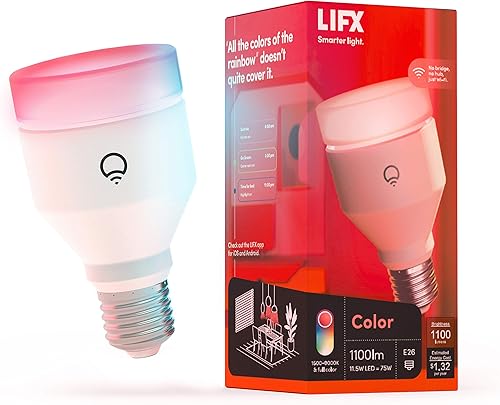
LIFX Color A19 (1100 lm)
~$12–20/bulbLIFX skips the hub entirely — each bulb has its own Wi-Fi radio — and pushes a rated 1100 lumens, noticeably brighter than the 800-lumen norm. Independent comparisons repeatedly single out LIFX for the most saturated, deepest color of the mainstream bulbs. The cost of going bridge-free is that every bulb sits on your Wi-Fi, so very large installs can strain a weak router, and there's no Thread radio (Matter runs over Wi-Fi on current firmware). For a handful of statement lights, it's the brightest, most vivid option here.
 Click to zoom
WiZ Color A19 (Matter)
~$8/bulb · 4-pack ~$33WiZ is Signify's budget brand — the same company behind Hue — and the current A19 ships Matter-compatible over Wi-Fi with no hub. At roughly $8 a bulb it's the value pick: full color, tunable white, motion-based automation, and native Alexa/Google control. Owners note it's not quite as bulletproof as Hue's Zigbee mesh and the app is more basic, but for the money it's the easiest recommendation for someone lighting a few rooms without buying into a hub.
 Click to zoom
Govee Smart Bulbs A19 (4-Pack)
~$7–8/bulb · 4-pack ~$28Govee's whole thing is effects per dollar. These 800-lumen RGBWW bulbs bring music sync (the app uses your phone mic to pulse the lights to sound) and dozens of preset scenes for a fraction of the premium brands. The catch worth flagging: this particular model is Wi-Fi/Bluetooth but does not support Matter, so it lives in the Govee app plus Alexa/Google rather than Apple Home. If you want color drama in a game room or bedroom and don't care about a unified smart-home standard, it's a lot of fun for the price.
 Click to zoom
Nanoleaf Essentials Matter A19
~$17/bulb · 3-pack ~$50If you're deep in Apple Home and have a Thread border router (a HomePod mini or Apple TV), the Nanoleaf Essentials is the standout. It's one of the few affordable bulbs that runs Matter over Thread rather than Wi-Fi, which means faster local response and no bulb clogging your wireless network. Rated around 1000 lumens with full color. Owner reports are broadly positive on responsiveness once Thread is set up, though the same reports note setup can be fiddly if you don't already have a border router — without one, you're limited to Bluetooth range.
The protocol under the bulb matters more than the color engine. Wi-Fi bulbs (LIFX, WiZ, Govee) need no hub but each one occupies an IP address and talks to the cloud, so a house full of them can overload a consumer router — most are rated for a few dozen devices before things get flaky. Zigbee (Hue) uses a low-power mesh through a bridge; every bulb repeats the signal, so reliability actually improves as you add bulbs, which is why big installs lean Hue. Thread (Nanoleaf Essentials) is the newer low-power mesh baked into Matter — like Zigbee it forms a self-healing mesh, but it needs a border router (a HomePod mini, Apple TV, or newer Echo) to bridge into your network. Rule of thumb: under ~10 bulbs, Wi-Fi is fine and cheapest; past that, a mesh (Zigbee or Thread) is worth the hub.
Side-by-Side Comparison
| Bulb | Rated Lumens | Protocol | Matter | Approx. $/bulb | Best for |
|---|---|---|---|---|---|
| Philips Hue W&C A19 | 800 | Zigbee + BT | Via Bridge | ~$50 | Whole-home reliability |
| LIFX Color A19 | 1100 | Wi-Fi | Over Wi-Fi | ~$12–20 | Brightness & color |
| WiZ Color A19 | 800 | Wi-Fi | Over Wi-Fi | ~$8 | Best value |
| Govee A19 | 800 | Wi-Fi + BT | No | ~$7–8 | Effects & music sync |
| Nanoleaf Essentials | ~1000 | Thread + BT | Over Thread | ~$17 | Apple Home / Thread |
Bottom Line
If you're lighting a whole house and want it to just work for years, Philips Hue earns its premium — the Zigbee mesh and mature app are still the reliability benchmark. If you want the brightest, most vivid bulb without buying a hub, LIFX is the one. For most people lighting a few rooms on a budget, the WiZ Color is the smartest money — Matter-ready and about a sixth of Hue's per-bulb cost. Grab Govee if you mainly want effects, and Nanoleaf Essentials if you're an Apple household with a Thread border router already in place.
© 2026 Loiter Point — Consumer tech reviews built on real evidence.