Best Drones Under $500 (2026 Guide)
The $500 ceiling is where the drone market gets genuinely interesting. Below it, you're making real compromises. At it, you can get a sub-250g 4K drone with GPS and decent obstacle avoidance — hardware that would have cost three times as much four years ago.
Every drone on this list has been flown, not just spec-compared. Here's what actually matters at this price point: real battery life (not DJI's hover-in-still-air number), how it handles wind, and whether the camera is usable for anything beyond basic video.
The Picks
 Click to zoom
The Mini 3 is the easiest recommendation at this price. Sub-250g, genuine 4K, vertical shooting mode, and DJI's ecosystem reliability. It's the Mini 4 Pro's little sibling with one meaningful cutback: obstacle sensing is forward and backward only, no side or upward detection. For most pilots flying open environments, that's an acceptable trade for $290 less than the Mini 4 Pro.
The catch: The Mini 3 (not Pro) doesn't shoot 4K/60fps — that's capped at 4K/30fps. If 60fps matters to you, the Mini 3 Pro at $759 or the Mini 4 Pro add it. For most content creators, 4K/30fps is fine.
Check Price on Amazon ↗The Nano+ earns its place with one feature DJI can't match: a RYYB sensor that collects 40% more light than a standard CMOS. In low-light conditions below EV1 — golden hour, indoor-adjacent environments, early morning — the Nano+ produces cleaner footage than the Mini 3. The tradeoff is a noticeably worse app experience and no geo-fencing restrictions, which is either a pro or a con depending on your situation.
The catch: Battery life is shorter than the Mini 3 and Autel's app is genuinely inferior to DJI Fly. If you fly near restricted airspace and use DJI's geo-fencing unlocking system, the Nano+ removes that workflow — good or bad depending on your use case.
Check Price on Amazon ↗ Click to zoom
If $469 is too much and you understand you're buying a starter drone, not a production tool, the HS720E is the most honest choice under $300. 4K EIS (electronic image stabilization — not a gimbal), GPS return-to-home, and about 23 minutes of real flight time. It will not produce footage you'd put in a professional project. It will teach you to fly and survive a reasonable number of crashes.
The catch: Over 250g means FAA registration required. EIS is not a gimbal — footage has significantly more wobble than DJI equivalents. No obstacle avoidance whatsoever. This is a beginner aircraft.
Check Price on Amazon ↗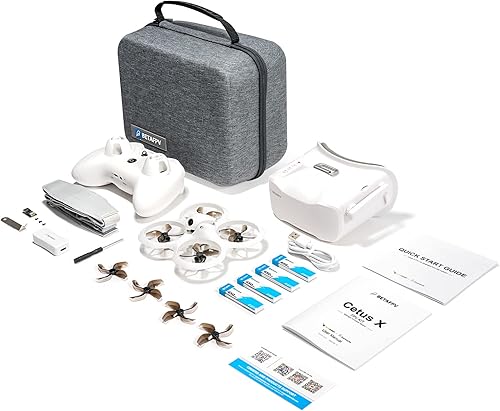 Click to zoom
If you want to get into FPV rather than cinematic drone work, the Cetus X is the cleanest entry point under $500. Brushless motors (not brushed like cheaper toy quads), digital HD video transmission, and a flight controller that runs Betaflight — the same software used on serious racing and freestyle quads. You will crash this. That's expected. Parts are cheap and available.
The catch: FPV flying has a real learning curve. Invest in simulator time (Liftoff, Velocidrone) before flying this in any space where crashing matters. The camera is FPV-quality, not cinematic — this is for the flying experience, not the footage.
Check Price on Amazon ↗Side-by-Side Comparison
| Drone | Price | Weight | Real Battery | 4K? | Gimbal? | Obstacle Avoid |
|---|---|---|---|---|---|---|
| DJI Mini 3 | $469 | 249g | 28–30 min | Yes (30fps) | 3-axis | Fwd/Bwd |
| Autel EVO Nano+ | $449 | 249g | 22–24 min | Yes (30fps) | 3-axis | 3-direction |
| Holy Stone HS720E | $189 | 436g | ~23 min | Yes (EIS) | No (EIS) | None |
| BetaFPV Cetus X | $199 | ~65g | 4–6 min | HD FPV | No | None |
Common Questions
Do I need to register my drone with the FAA?
If your drone weighs between 0.55 lbs (250g) and 55 lbs, you must register with the FAA for $5. The DJI Mini 3 and Autel Nano+ both come in at 249g — under the threshold. The Holy Stone HS720E is 436g and requires registration. For recreational flying, registration is at faa.gov/uas. For any commercial use, you also need FAA Part 107 certification.
Is the DJI Mini 3 worth it over a cheaper drone?
Yes, for almost everyone. The difference between a $189 drone and a $469 DJI Mini 3 is the difference between a toy and a tool. The 3-axis gimbal alone — which produces smooth, stable footage regardless of wind — justifies the price gap if you care about video quality at all. Buy the cheapest DJI over a premium "budget" drone every time.
What's the difference between the DJI Mini 3 and Mini 3 Pro?
The Mini 3 Pro ($759) adds omnidirectional obstacle avoidance and 4K/60fps. The Mini 3 ($469) has forward/backward obstacle sensing only and is capped at 4K/30fps. The sensor and image quality are nearly identical. If you're flying in environments with obstacles (trees, buildings, crowds), the Pro's full obstacle avoidance is worth the premium. If you fly open landscapes, save the money.
Can I fly a drone in my city?
It depends on your specific location. Most urban areas have restricted airspace that requires LAANC authorization via apps like Aloft or B4UFLY before flying. Some areas are simply off-limits. Check B4UFLY before every flight in an unfamiliar location. Flying in restricted airspace without authorization carries real fines — don't skip this step.
What about DJI's geo-fencing?
DJI drones enforce geo-fencing — a software lock that prevents flight in restricted zones. You can unlock many zones through DJI's system if you're authorized. Autel drones have no geo-fencing, which means the responsibility for airspace compliance sits entirely with you. That's not a license to fly anywhere — it just removes the software guardrail.
Bottom Line
For most people reading this: buy the DJI Mini 3. It's the most capable drone under $500 from the most reliable ecosystem. If low-light performance is your priority and you can live with a worse app, consider the Autel Nano+. If you're a true beginner who wants to learn to fly before spending real money, the Holy Stone HS720E is a legitimate starter. If FPV is your goal, the BetaFPV Cetus X is where to start.
Don't buy a $50–100 toy drone from an unknown brand. You'll fly it twice, crash it, and spend the money on a real drone anyway.
Ready to spend more for pro features? Our best drones of 2026 guide covers the flagship models worth the jump.