The Best Portable Air Conditioners of 2026, Ranked by the Evidence
A portable AC is the appliance people buy in a panic, in a heatwave, from whatever spec sheet shouts the biggest number. That number is almost always misleading. The "14,000 BTU" printed on the box is an old ASHRAE rating; the figure that predicts whether a unit will actually cool your room is the smaller DOE/SACC number, and it can be 30–40% lower. We ranked the best portable air conditioners of 2026 around the specs that decide comfort — real SACC capacity, hose design, noise, and energy draw — using published independent testing and owner reports rather than marketing copy.
THE SHORT VERSION
- Best overall: the Midea Duo MAP14S1TBL — an inverter, dual-hose design that independent reviewers repeatedly rate the fastest-cooling and most efficient unit tested, and one of the quietest.
- Quietest / easiest to install: the LG LP1419IVSM Dual Inverter — arrives with the hose pre-attached and runs into the low-40s dB in sleep mode per testers.
- Best dual-hose value: the Whynter ARC-14S — a long-running, durable dual-hose workhorse with a strong owner-reliability record.
- Best budget / small rooms: the Black+Decker BPACT08WT — cheap, light, and honest about its limits (small rooms only).
- Best year-round (heat + cool): the Midea Duo MAP14HS1TBL — the same top-rated Duo with a heat-pump mode for shoulder-season nights.
How We Evaluate Portable Air Conditioners
Loiter Point does not run a climate lab, and we are not going to pretend otherwise. Instead we synthesize the best published independent measurements we can find — cooling and efficiency testing from outfits like Reviewed, Bob Vila, and ConsumerAnalysis, plus hands-on setup and noise notes from mainstream reviewers — and cross-check all of it against a large volume of verified owner reports. When a figure is a manufacturer rating rather than an independent measurement, we label it "rated." When it comes from testing or owners, we frame it that way.
Four things separate a portable AC that cools from one that just hums and drips, and we weight them in this order: real cooling capacity (SACC/DOE, not the inflated ASHRAE number) matched to your actual room size; hose design, because a dual-hose unit is meaningfully more efficient than a single-hose one for the same rated BTUs; noise, since this thing lives in your bedroom or office and runs for hours; and energy draw and drainage (inverter compressors and self-evaporation save money and hassle). Price matters, but the cheapest unit that can't hold your room below 78°F on the hottest day is not a bargain.
The Picks
 Click to zoom
Midea Duo MAP14S1TBL
~$500The Midea Duo is the unit independent reviewers keep crowning. Its trick is a hose-in-hose ("Duo") design paired with a variable-speed inverter compressor — the combination that Reviewed and Bob Vila credit for cooling a room faster while drawing less electricity than any other portable they've tested. The concentric hose largely defeats the negative-pressure problem that plagues single-hose units (more on that below), and independent testers have logged it in the low-to-mid 40s dB in sleep mode, quiet enough for a bedroom. Self-evaporation vents most condensate out the exhaust, so you rarely empty a tank. It is not the cheapest box on the shelf, but on the evidence it is the least-compromised buy for a mid-to-large room. If you're also fighting humidity, our dehumidifier guide covers standalone options that pair well with it.
| Capacity | 14,000 BTU ASHRAE / 12,000 BTU SACC (rated) |
| Room size | Up to ~550 sq ft (rated) |
| Hose design | Dual hose-in-hose |
| Compressor | Variable-speed inverter |
| Noise | ~42–49 dB depending on mode (independent tests, reported) |
| Smart | Wi-Fi · Alexa / Google Assistant · remote |
 Click to zoom
LG LP1419IVSM Dual Inverter
~$600If low noise and a painless install top your list, the LG is the pick. Reviewers repeatedly single it out as the easiest unit to set up — the exhaust hose ships already attached to the back — and its dual-inverter compressor is among the quietest tested, with testers reporting sleep-mode figures in the mid-40s dB. It is a single-hose design, so it is a touch less efficient than the dual-hose units here, but the inverter compressor claws much of that back and keeps running costs reasonable. A sensible choice for a bedroom up to roughly 500 square feet where you value quiet over squeezing out the last percent of efficiency.
| Capacity | 14,000 BTU ASHRAE / 10,000 BTU SACC (DOE) (rated) |
| Room size | Up to ~500 sq ft (rated) |
| Hose design | Single hose |
| Compressor | Dual inverter |
| Noise | ~44 dB sleep mode (independent tests, reported) |
| Smart | Wi-Fi · LG ThinQ app · remote |
 Click to zoom
Whynter ARC-14S
~$500The ARC-14S has been a dual-hose staple for years, and that longevity is the point: owner reports show a strong reliability record, and reviewers keep recommending it as the efficient, no-frills alternative to the pricier inverter units. It is not an inverter — the compressor is single-speed — so it cycles rather than modulating, and it lacks the app connectivity of the Midea and LG. But the true dual-hose plumbing makes it more efficient than similarly rated single-hose boxes, and it doubles as a dehumidifier and fan. If you want dual-hose efficiency and durability without paying the inverter premium, this is the value play.
| Capacity | 14,000 BTU ASHRAE / 9,500 BTU SACC (rated) |
| Room size | Up to ~500 sq ft (rated) |
| Hose design | Dual hose |
| Compressor | Single-speed |
| Extras | Dehumidifier + fan modes · activated-carbon filter · remote |
 Click to zoom
Black+Decker BPACT08WT
~$280Most of the "cheap" portable ACs online are a trap — a big ASHRAE number hiding a tiny real capacity. The Black+Decker BPACT08WT is the honest budget pick because it is upfront about being small: an 8,000 BTU ASHRAE unit whose SACC rating lands around 4,000 BTU, which realistically means a bedroom, office, or nursery rather than a great room. Within that envelope it is light, easy to roll between rooms, simple to install, and cheap. Just size it to the space — buy it for a 150–250 sq ft room and it performs; ask it to cool an open-plan living area and it will disappoint. Owner reports are consistently positive when it is matched to the right room.
| Capacity | 8,000 BTU ASHRAE / ~4,000 BTU SACC (rated) |
| Room size | Best for small rooms (~150–250 sq ft, realistic) |
| Hose design | Single hose |
| Extras | 3-in-1 AC / fan / dehumidifier · "Follow Me" remote · window kit |
 Click to zoom
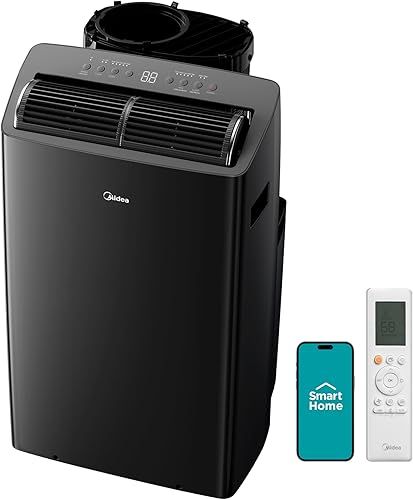
Midea Duo MAP14HS1TBL (Heat + Cool)
~$600This is the same top-rated Midea Duo as our #1 pick — dual hose-in-hose, inverter compressor, self-evaporation, Wi-Fi — with a heat-pump mode added. That makes it a genuine three-season appliance: it cools through summer, then takes the chill off cool spring and autumn nights without a separate space heater. The heat-pump function is more efficient than a resistive heater and useful in mild climates, though it is not a replacement for central heating in a hard freeze. If you want one box that earns its storage space most of the year, the modest premium over the cooling-only Duo is easy to justify.
| Capacity | 14,000 BTU ASHRAE / 12,000 BTU SACC cooling + heat-pump mode (rated) |
| Room size | Up to ~550 sq ft (rated) |
| Hose design | Dual hose-in-hose |
| Compressor | Variable-speed inverter |
| Smart | Wi-Fi · Alexa / Google Assistant · remote |
Nerd Box · ASHRAE vs SACC, and why single-hose units fight themselves
Two pieces of physics decide whether a portable AC will actually cool your room, and both are hidden by the marketing. First, the BTU number. The big figure on the box (say "14,000 BTU") is an ASHRAE rating measured under conditions that flatter the unit. Since 2017 the U.S. Department of Energy has required the SACC ("Seasonally Adjusted Cooling Capacity," sometimes shown as DOE BTU), a tougher standard that accounts for real-world losses — including heat leaking back in through the exhaust hose. SACC is typically 30–40% lower, which is why a "14,000 BTU" unit is really more like 10,000–12,000 BTU of usable cooling. Always size a room to the SACC number, never ASHRAE.
Second, the hoses. A single-hose unit takes air from inside the room, uses it to cool the coils, and blows the hot exhaust outside. But every cubic foot it sends out the window has to be replaced — so the room sucks in warm, unconditioned air through every gap around doors and windows (negative pressure). You are, in effect, cooling air and then paying to pull warm air back in. A dual-hose design (or the Midea's concentric hose-in-hose) pulls outdoor air through a separate intake to cool the coils, so it doesn't depressurize the room. That's the main reason the dual-hose Midea and Whynter here punch above their SACC ratings, and why a single-hose unit needs a bit more capacity to do the same job.
Side-by-Side
| Model | Street price | SACC (real) | ASHRAE | Hose | Compressor | Best for |
|---|---|---|---|---|---|---|
| Midea Duo MAP14S1TBL | ~$500 | 12,000 BTU | 14,000 BTU | Dual (hose-in-hose) | Inverter | Best overall |
| LG LP1419IVSM | ~$600 | 10,000 BTU | 14,000 BTU | Single | Dual inverter | Quiet / easy install |
| Whynter ARC-14S | ~$500 | 9,500 BTU | 14,000 BTU | Dual | Single-speed | Dual-hose value |
| Black+Decker BPACT08WT | ~$280 | ~4,000 BTU | 8,000 BTU | Single | Single-speed | Budget / small rooms |
| Midea Duo MAP14HS1TBL | ~$600 | 12,000 BTU | 14,000 BTU | Dual (hose-in-hose) | Inverter | Heat + cool, year-round |
Prices are recent street prices and fluctuate heavily — portable ACs spike during summer heatwaves and drop in the off-season. SACC and ASHRAE figures are manufacturer ratings. Always confirm the live price and the exact model on the product page before buying.
Bottom Line
For most people cooling a bedroom or living room, the Midea Duo MAP14S1TBL is the unit to buy: on the published evidence it cools fastest, runs quietly, and costs the least to run thanks to its inverter and dual-hose design. Prioritize silence and a no-fuss install and the LG LP1419IVSM is the better bedroom companion; want dual-hose efficiency without the inverter premium and the Whynter ARC-14S is the durable value pick. For a small room on a tight budget, the Black+Decker BPACT08WT is honest about its limits, and the heat-pump Midea Duo MAP14HS1TBL earns its keep three seasons a year. Whatever you choose, size it to the SACC number and favor dual-hose if your room has lots of gaps — that's the difference between a room that actually cools and a box that just makes noise. While you're improving your air, our guides to the best air purifiers and smart thermostats pair naturally with a new AC.
Affiliate disclosure: Loiter Point earns commissions from qualifying purchases made through the Amazon links on this page (Amazon Associates tag: loiterpoint20-20). This never changes what we recommend or how we rank — our picks are driven by published independent testing and verified owner reports, not by commissions. We do not run a testing lab and never claim first-hand measurements we didn't make.
© 2026 Loiter Point — Consumer tech reviews built on real evidence.