The Best Standing Desks of 2026, Ranked by Wobble
A standing desk lives or dies on one boring spec almost no spec sheet mentions: how much it shakes at full height. Motors, memory presets, and bamboo tops are easy; a frame that stays dead still with a 32-inch monitor bouncing on it at 46 inches is not. We ranked the best electric sit-stand desks of 2026 around that reality, using published independent wobble testing and owner reports rather than marketing copy.
THE SHORT VERSION
- Best overall: the Vari Electric Standing Desk (60×30) — the least-fussy desk to assemble and among the steadiest at typing height, per independent reviewers.
- Best for heavy, multi-monitor loads: the FlexiSpot E7 Plus — a four-leg frame rated to lift 440 lb with a 15-year frame warranty.
- Most customizable (sold direct): the UPLIFT V2-Commercial — Wirecutter's long-running pick, with the industry's most all-inclusive 15-year warranty.
- Best budget: the FEZIBO 48×24 Dual Motor — a genuine dual-motor desk under $200 that punches above its price for a single-monitor setup.
How We Evaluate Standing Desks
Loiter Point does not run a furniture lab, and we are not going to pretend otherwise. Instead, we synthesize the best published independent measurements we can find — dedicated wobble-testing outfits like BTOD/WorkWhileWalking that push desks side-to-side and front-to-back with weighted loads, plus hands-on assembly and stability reviews from Tom's Guide, TechRadar, and Wirecutter — and cross-check those against a large volume of verified owner reports. When a number is a manufacturer rating rather than an independent measurement, we label it "rated." When it comes from testing or owners, we frame it that way.
Four things separate a good sit-stand desk from a shaky one, and we weight them in this order: front-to-back (longitudinal) stability at standing height, which is where nearly every desk struggles; weight capacity and leg design (three-stage legs raise faster but can add sway; a crossbar or four-leg base trades legroom for rigidity); warranty depth, because motors and controllers are the parts that fail years in; and assembly and daily usability. Price matters, but a cheap desk that vibrates every time you type is not a bargain.
The Picks
 Click to zoom
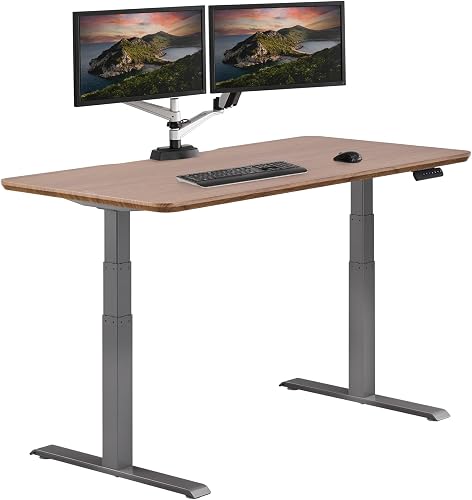
Vari Electric Standing Desk (60×30)
~$695Vari's calling card is that it arrives essentially pre-built: the desktop ships as one piece with the legs attached, and independent reviewers repeatedly single it out as the fastest premium desk to set up — a matter of minutes, not the usual hour of bolting a frame together. Tom's Guide and TechRadar both describe the T-style legs as notably sturdy for a two-leg design, and owner reports back that up for single- and dual-monitor setups at normal typing heights. It is not the cheapest way to get a motorized desk, and the dual-motor frame tops out lower than the heavy-duty four-leg options below, but for most people it is the least-compromised buy.
| Height range | 25–50.5 in (rated) |
| Weight capacity | 200 lb (rated) |
| Motor / presets | Dual motor · 4 memory presets |
| Stability | Very steady at sitting/typing height; some sway near max, per reviews (reported) |
| Warranty | Lifetime on frame for most popular models; verify current terms per size |
FlexiSpot E7 Plus
~$480If you run a triple-monitor rig, a heavy arm, or simply want a frame that will not flinch, the E7 Plus is the value answer. Its distinctive four-leg base (each foot pairing two uprights) is what reviewers credit for its "rock-solid" rating, and FlexiSpot rates the frame to lift up to 440 lb — far beyond anything a desk-full of gear will ask of it. Height adjustments run under 50 dB in independent testing. The catch is the warranty split: 15 years on the frame, motors, and electronics, but only 2 years on laminate tops and 5 on solid wood — worth knowing if you're picking a surface. We couldn't confirm a single stable Amazon ASIN for the exact configuration, so the button below is a filtered Amazon search.
| Height range | ~24.4–50 in (rated, top on) |
| Weight capacity | Lifts up to 440 lb (rated) |
| Motor / presets | Dual motor · 3-stage legs · 4 presets |
| Noise | Under 50 dB (independent tests) |
| Warranty | 15 yr frame/motor/electronics · 2 yr laminate top · 5 yr solid wood |
UPLIFT V2-Commercial
from ~$600UPLIFT has been Wirecutter's standing-desk pick for years running, and the reason is customization: dozens of desktop materials, sizes, and accessories, plus a genuinely industry-leading warranty. The V2-Commercial adds a steel crossbar to the standard V2, and independent wobble testing (BTOD) found it among the most laterally stable frames they've measured — as steady side-to-side as desks costing far more. Be honest about the trade-off, though: the same testing notes meaningful front-to-back wobble once you raise it past roughly 46 inches, so very tall users should temper expectations. UPLIFT sells direct rather than through Amazon, so the link below is an Amazon search; the desk itself ships from upliftdesk.com.
| Height range | 22.6–48.7 in, frame only (rated) |
| Weight capacity | 355 lb (rated) |
| Stability | Excellent lateral; front-to-back sway above ~46 in (independent wobble tests) |
| Noise | ~53–60 dB under load (independent tests) |
| Warranty | 15 yr, all-inclusive — frame, motors, electronics, and top |
 Click to zoom
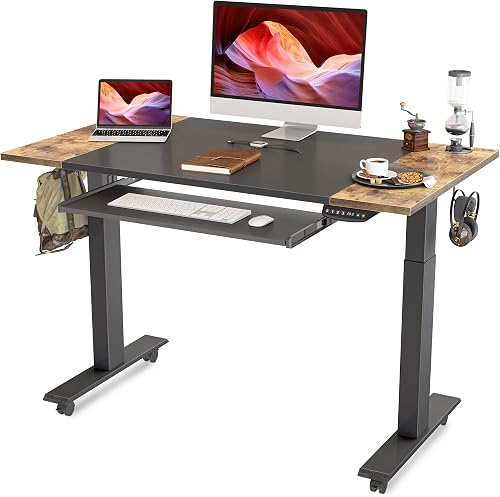
FEZIBO 48×24 Dual Motor
~$190Most sub-$200 "standing desks" hide a single motor, which means slow, groaning lifts and worse stability. The FEZIBO 48×24 is a real dual-motor desk at that price, with three memory presets, motors rated under 45 dB, and a steel frame FEZIBO says is tested to 50,000 lift cycles. Its 176 lb rated capacity and 46.5-inch max height put a ceiling on it — this is a single-monitor, one-person desk, not a heavy-duty workstation, and taller users will run out of height — but for a first standing desk or a secondary setup, owner reports are consistently positive for the money.
| Height range | 28.3–46.5 in (rated) |
| Weight capacity | 176 lb (rated) |
| Motor / presets | Dual motor · 3 presets |
| Noise | Under 45 dB (rated) |
| Warranty | Limited manufacturer warranty — verify current terms |
Nerd Box · Why desks wobble front-to-back, not side-to-side
When people complain that a standing desk "shakes," they almost always mean longitudinal wobble — the desktop rocking toward and away from you — not lateral, side-to-side sway. There's a physical reason. The legs are wide apart left-to-right, giving a broad base against sideways force, but shallow front-to-back, so a small push (like the recoil of typing) creates a longer lever that the frame resists poorly. Raising the desk makes it worse: a three-stage leg is a taller, thinner stack of nested tubes, and every added inch increases the leverage acting on the tiny amount of play in each joint. That's why independent testers see frames rated "excellent" at 30 inches turn shaky past 46. Two fixes work: a crossbar (rigid but eats legroom) or a four-leg base like the E7 Plus (rigid without the bar, at higher cost). If you're over six feet tall and stand often, prioritize front-to-back stability data over headline capacity numbers — capacity is almost never the thing that fails you.
Side-by-Side
| Desk | Street price | Height (rated) | Capacity (rated) | Warranty | Best for |
|---|---|---|---|---|---|
| Vari Electric (60×30) | ~$695 | 25–50.5 in | 200 lb | Lifetime frame (most models) | Easiest buy overall |
| FlexiSpot E7 Plus | ~$480 | ~24.4–50 in | Lifts 440 lb | 15 yr frame / 2 yr laminate | Heavy multi-monitor loads |
| UPLIFT V2-Commercial | from ~$600 | 22.6–48.7 in | 355 lb | 15 yr all-inclusive | Customization + warranty |
| FEZIBO 48×24 | ~$190 | 28.3–46.5 in | 176 lb | Limited | Budget / single monitor |
Prices are recent street prices and fluctuate — especially the Vari and UPLIFT, which run frequent promotions. Always confirm the live price and the exact size/top configuration on the product page before buying.
Bottom Line
For most people, the Vari Electric Standing Desk is the desk to buy: it is the least painful to assemble and steady where you actually work. If your setup is heavy or you want the longest-lived frame, the FlexiSpot E7 Plus and its four-leg base is the value pick, while the UPLIFT V2-Commercial earns its price on customization and a warranty nobody else matches. And if you just want to try standing without spending big, the FEZIBO 48×24 is a real dual-motor desk for under $200. Whatever you pick, judge it on front-to-back stability at your standing height — that's the spec you'll feel every single day.
Affiliate disclosure: Loiter Point earns commissions from qualifying purchases made through the Amazon links on this page (Amazon Associates tag: loiterpoint20-20). This never changes what we recommend or how we rank — our picks are driven by published independent testing and verified owner reports, not by commissions. We do not run a testing lab and never claim first-hand measurements we didn't make.
© 2026 Loiter Point — Consumer tech reviews built on real evidence.