Best Soundbars (2026): Ranked on Independent Testing
- Best overall: the Samsung HW-Q990F (list $1,999, routinely ~$999–1,100) — the 11.1.4 system independent labs rank at the top for full, discrete surround with real rear speakers and a big subwoofer in the box.
- Best all-in-one premium: the Sonos Arc Ultra (~$999, list $1,099) — one slim bar, no clutter, and a new woofer design reviewers say delivers bass no bar this thin used to manage.
- Best for gaming: the Sony Bravia Theatre Bar 9 (~$1,399) — the rare flagship with a real HDMI 2.1 passthrough input for 4K/120, VRR and ALLM.
- Best compact: the Sonos Beam (Gen 2) ($499, often ~$399) — a small, single-bar upgrade for a bedroom or a small living room, with virtual Atmos.
- Best value: the Hisense AX5140Q (~$379, list $399.99) — a full 5.1.4 kit with wireless sub, discrete rears and genuine up-firing height drivers for well under half the Samsung's street price.
How We Evaluate Soundbars
Loiter Point does not run a test lab, and we won't pretend otherwise. Soundbars are a category where that honesty matters, because "Dolby Atmos," channel counts, and quoted wattage are the three things marketed most aggressively and understood least. Our rankings synthesize published independent measurements — primarily from RTINGS, whose soundbar bench is the most thorough in the business, plus What Hi-Fi? and Consumer Reports — cross-checked against long-term owner reports that surface what a one-week review misses: HDMI handshake bugs after a firmware update, subwoofers that drop their wireless link, and rear speakers that need their own power outlets. The most useful thing independent labs do here is measure a bar's actual frequency response, maximum clean loudness, and how convincingly it steers height and surround effects — not just repeat the box's channel numbers. Where a spec and the measured reality diverge, we say so. Prices were checked in July 2026; soundbars discount harder and more often than almost any other tech category, so treat list prices as ceilings and the street prices below as the number that actually matters.
The Picks
 Click to zoom
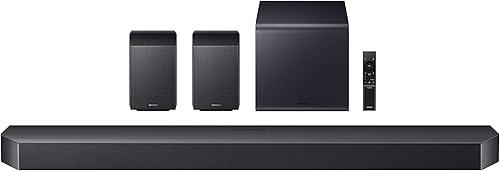
Samsung HW-Q990F
RTINGS calls the HW-Q990F the best soundbar it has tested, and the reasoning is straightforward: almost nothing else in one box gives you a genuine 11.1.4 layout — a wide front bar, a substantial wireless subwoofer, and two discrete wireless rear speakers with their own up-firing height drivers. That's real surround and real overhead, not a virtualized approximation, and independent reviewers consistently describe it as the most complete, enveloping home-theater effect available without wiring in a full AV receiver. What Hi-Fi? gives the current generation five stars and specifically flags a bass upgrade over the prior model. The honest caveats: the rear speakers need mains power, so you're running cables to the back of the room even though the audio link is wireless; and at 11.1.4 it can overwhelm a genuinely small room. Note too that the "$1,999" list price is theater, not reality — this bar is discounted so routinely that owner reports and price trackers put the real buying window closer to $999–1,100, which is where it becomes the easy top recommendation. If you want the biggest, most complete sound and have a medium-to-large room, buy this one.
Check price on Amazon → Click to zoom
Sonos Arc Ultra
If the Samsung's box of speakers and cables sounds like too much, the Arc Ultra is the elegant answer: a single slim bar that reviewers rank at or near the top for premium all-in-one sound. Its headline is a redesigned "Sound Motion" woofer that What Hi-Fi? and others credit with delivering genuinely deep bass from an enclosure this thin — historically the compromise you accepted for a no-subwoofer bar. It's also the smart-home pick, folding into the wider Sonos ecosystem so you can later add a Sub and rears if you want to grow toward true surround. Two honest limitations decide whether it's for you. First, it ships as a bar alone — no subwoofer or rears in the box — so out of the box it can't match the Samsung's discrete surround envelope. Second, it has HDMI eARC only, with no additional HDMI inputs, so it's a poor fit if you need the bar to switch multiple 4K sources or pass through a 4K/120 gaming signal (see the Sony below). For most people who want one beautiful bar that sounds far bigger than it looks, it's the premium default.
Check price on Amazon → Click to zoom
Sony Bravia Theatre Bar 9 (HT-A9000)
The Theatre Bar 9 earns its spot for one feature the other flagships skip: a dedicated HDMI 2.1 passthrough input that carries 4K/120Hz, VRR and ALLM. On most TVs you only get two HDMI 2.1 ports, and one is the eARC output the soundbar occupies — so a bar without its own 2.1 input forces your PS5 or gaming PC to share the TV's remaining high-bandwidth port. The Sony sidesteps that entirely, which is why What Hi-Fi? singles it out for gamers. Beyond the ports, its 13 speakers and Sony's 360 Spatial Sound Mapping produce a rich, detailed soundstage that reviewers say competes with the Samsung on movies, and multiple outlets praise its dialogue clarity in particular. The caveats are money and completeness: at roughly $1,399 it's a bar and nothing else — no sub, no rears in the box — so matching the Samsung's low-end and surround means buying Sony's optional wireless subwoofer and rear speakers on top. If you game on a 4K/120 console or PC and want a premium bar that won't bottleneck your display, this is the one built for you.
Check price on Amazon → Click to zoom
Sonos Beam (Gen 2)
When the room is small or the budget can't stretch to a flagship, the Beam (Gen 2) is the compact upgrade reviewers keep returning to. At roughly 25.6 inches it fits under a 40-something-inch TV without dominating the console, and it delivers the clean, well-balanced Sonos house sound plus the same app and multiroom smarts as the pricier bars. It's the "gold standard for smart soundbars that grow with your system" precisely because you can later add a Sub Mini and a pair of Era speakers to build toward real surround. Be clear-eyed about the Atmos, though: the Beam creates height virtually through processing rather than firing sound off your ceiling, so it does not deliver the overhead effect of the up-firing bars above — reviewers treat its Atmos as a subtle widening, not a dome of sound. And like every Sonos here, there's no HDMI input beyond eARC. For a bedroom, an apartment, or anyone who wants a meaningful step up from TV speakers without a subwoofer box on the floor, it's the compact pick. Pairing it with late-night listening gear? Our best noise-canceling headphones guide covers the private-listening half of home audio.
Check price on Amazon → Click to zoom
Hisense AX5140Q
The AX5140Q is the value story of 2026, and RTINGS ranks it the best budget soundbar it has tested. For well under half the Samsung's street price you get a genuinely complete discrete layout: a soundbar, a wireless subwoofer, two wireless rear surround speakers, and four true up-firing height drivers — a real 5.1.4 kit rather than a bar faking surround through processing. That configuration is essentially unheard of at this price, and independent reviewers describe surprisingly big, room-filling sound with effective overhead effects; one hands-on write-up noted bass loud enough to vibrate the walls. The honest tradeoffs are the ones you'd expect a few hundred dollars below the flagships: the tuning is less refined than the Samsung or Sonos, the app and calibration are more basic, and the rear speakers — as with the Samsung — still need to be plugged into power. But if your priority is the most complete surround-and-height system for the least money, nothing here comes close on value. Feeding it from a streaming stick or console? See our best streaming devices guide for the source side of the setup.
Check price on Amazon →The three numbers on a soundbar box decode cleanly. The first is ear-level channels (fronts, center, surrounds); the second is subwoofers; the third is height channels that create overhead sound. So the Samsung's 11.1.4 means eleven ear-level speakers, one sub, and four upward-firing height drivers, while the Sonos Beam's effective 5.0 means no separate sub and no dedicated height drivers at all. That third number is where marketing gets slippery: a bar can claim "Dolby Atmos" two very different ways. Real Atmos uses up-firing drivers that bounce sound off your ceiling so effects come from above — the Samsung, Sony and Hisense do this. Virtual Atmos, like the Beam's, uses processing to fake height from front-firing drivers; it can widen the sound but can't put a helicopter over your head. Neither is fraud, but they are not equivalent, and the box rarely tells you which you're getting. One more spec that decides real-world happiness: HDMI eARC vs. ARC. Only eARC has the bandwidth to carry full, uncompressed Atmos and DTS:X from your TV to the bar; plain ARC compresses it. Every pick here supports eARC — but if you pair any of them with an older TV that only has ARC, you quietly lose the very format you paid for.
Comparison Table
| Soundbar | Street price | Config | Atmos type | Sub + rears in box? | Best for |
|---|---|---|---|---|---|
| Samsung HW-Q990F | ~$999–1,100 | 11.1.4 | Real (up-firing) | Yes — both | Best complete surround |
| Sonos Arc Ultra | ~$999 | 9.1.4 (bar) | Real (up-firing) | No | One-bar premium |
| Sony Theatre Bar 9 | ~$1,399 | 13 spk · 7.0.2 | Real (up-firing) | No | 4K/120 gaming |
| Sonos Beam (Gen 2) | ~$369–499 | Compact 5.0 | Virtual | No | Small rooms |
| Hisense AX5140Q | ~$348–399 | 5.1.4 | Real (up-firing) | Yes — both | Best value surround |
Config and Atmos type reflect manufacturer specs; "best for" reflects the consensus of published independent testing (RTINGS, What Hi-Fi?, Consumer Reports) and owner reports — not our own lab, which we don't have. Prices are July 2026 street estimates and move constantly.
What We'd Skip
Three honest warnings. First, don't buy a flagship bar-only system thinking you're done — the Sonos Arc Ultra and Sony Bar 9 are superb, but without their optional subs and rears they can't match a complete 5.1.4 or 11.1.4 kit for surround, and those add-ons cost real money. If you want full surround on one invoice, the Samsung and Hisense are the honest answers. Second, be skeptical of cheap bars advertising huge "Dolby Atmos" in the title with only two front-firing drivers; that's virtual height at best, and often just a stereo bar with a processing badge. Third, match the bar to your TV's HDMI: you need an eARC port to get uncompressed Atmos, and if you game at 4K/120 you want either a bar with its own HDMI 2.1 input (the Sony) or a spare 2.1 port on the TV. Buy for the room and the sources you actually have, not the biggest channel number on the box.
Bottom Line
Most people with a real living room should buy the Samsung HW-Q990F — it's the most complete surround-and-height system in a box, and its street price lands far below the scary list number. If you want one elegant bar with no clutter, the Sonos Arc Ultra is the premium all-in-one pick. Gamers on a 4K/120 console should step to the Sony Bravia Theatre Bar 9 for its HDMI 2.1 passthrough. For a bedroom or apartment, the compact Sonos Beam (Gen 2) is the smart upgrade. And if you want the most surround for the least money, the Hisense AX5140Q gives you a real 5.1.4 kit for around $379. For portable sound around the house, our best Bluetooth speakers guide covers the other half of the audio picture.