Best Sleep Trackers (2026)
Five trackers ranked by what independent labs actually measured against polysomnography — not marketing copy.
TL;DR — The Short Version
- Best overall: the Oura Ring 4 is the most independently validated sleep-staging device you can buy — and the most comfortable, since there's nothing on your wrist.
- Athletes and recovery nerds: the WHOOP 5.0 pairs lab-close overnight HR/HRV with the best strain-and-recovery coaching, if you accept a subscription-forever model.
- Best value with a screen: the Fitbit Charge 6 routinely drops under $100 and covers the sleep basics well — staging just isn't as sharp as Oura's.
- No subscription, ever: the Ultrahuman Ring Air and the bedside Withings Sleep pad give you lifetime features with no monthly bill.
- GRAB YOUR PICK: Oura Ring 4 — from $349 · WHOOP 5.0 — from $199/yr · Fitbit Charge 6 — $159 (often under $100) · Ultrahuman Ring Air — $349, no sub · Withings Sleep — ~$130
How We Evaluate Sleep Trackers
Loiter Point does not run a sleep lab. We don't strap on ten wearables and claim to have "tested" them against a hospital polysomnograph — almost nobody outside a clinical research group actually does that, and the ones who do publish their work. So our job is to read that published work carefully, cross-check it against verified owner reports, and translate it into a buying decision.
The anchor for staging accuracy in this guide is a Brigham and Women's Hospital study (published in Sensors, 2024) that compared several consumer wearables head-to-head against polysomnography (PSG) — the clinical gold standard, where a technician scores your sleep stages from brain waves, eye movement, and muscle activity. That study is the single best apples-to-apples comparison of these devices' four-stage classification, and it does most of the heavy lifting below. We also lean on a 2025 systematic review and meta-analysis (OTO Open) that placed Oura against medical-grade sleep studies, plus manufacturers' own published validation figures — clearly labeled as such, because a company grading its own homework is weaker evidence than an independent lab doing it.
Everything in the spec grids that reflects real usage — battery life you'll actually see, staging performance — is labeled "reported" or "est. real-world." Manufacturer ratings are labeled as ratings. Where the independent evidence is thin (Ultrahuman's validation record, for example) or the pricing is all over the place (Withings), we say so plainly rather than papering over it. That's the whole point of the site.
The 5 Best Sleep Trackers
 Click to zoom
Oura Ring 4
$349–$499 list (silver typically $349–$399) · Oura Membership $5.99/mo or $69.99/yr, 12 months included
If you care most about the number the device puts next to "REM" and "Deep" being right, the Oura Ring 4 is the pick. In the Brigham and Women's PSG comparison, Oura posted the strongest four-stage classification of the consumer wearables tested — a Cohen's kappa of 0.65, ahead of the Apple Watch (0.60) and Fitbit (0.55), with sensitivity of 76.0–79.5% and precision of 77.0–79.5%. Oura's own published validation lands in the same neighborhood, around 79% agreement with PSG for four-stage classification, and a 2025 systematic review reached similar conclusions. No consumer sleep tracker has a deeper independent validation record right now.
The ring form factor is the quiet reason it wins. There's nothing strapped to your wrist, nothing to press into the mattress, nothing glowing at 3 a.m. It's the tracker you actually forget you're wearing, which matters more for sleep data than any spec — a device you take off is a device that logs nothing. The app is genuinely good, and the temperature-trend and cycle-tracking insights are among the most useful in the category.
Two honest caveats. First, the subscription: after the 12 months bundled with a new ring, Oura Membership renews at $69.99/yr, and without it you lose most of the insights that justify the purchase. Budget for it. Second, sizing — Oura sells per-size ASINs, so order the free sizing kit from Oura first and treat the Amazon listing as your entry point, not a guaranteed fit. And there's no screen, so notifications and at-a-glance time aren't part of the deal.
Check price on Amazon → Click to zoom
WHOOP 5.0
Hardware bundled with membership: One $199/yr, Peak $239/yr, Life $359/yr · the One Bundle here includes 5.0 hardware, 12-month membership, CoreKnit band & charger
WHOOP isn't really a gadget you buy — it's a subscription that happens to ship with hardware. Since the May 2025 relaunch, pricing has been stable: the One tier runs $199/yr (about $25/mo), Peak is $239/yr, and Life is $359/yr, the last using WHOOP's MG hardware with ECG and blood-pressure features. That makes it the most expensive ongoing-cost option in this guide, full stop. But for the right person it earns it.
That person is training hard and wants sleep framed as recovery. WHOOP's strength is stitching overnight heart rate and HRV into a strain-and-recovery model, with a sleep coach that tells you when to go to bed to hit a target. Independent testing repeatedly places WHOOP with Oura as the closest consumer devices to lab-grade for overnight HR and HRV, which is exactly the signal its recovery scoring leans on. Worn 24/7 with no screen to distract you, it's built to disappear into a routine.
The catch is philosophical as much as financial: you never stop paying, and if you cancel, the band stops being useful. If all you want is a nightly sleep score, WHOOP is overkill and Oura or Fitbit will cost you far less over three years. If you live in your training data, it's the best tool here.
Check price on Amazon → Click to zoom
Fitbit Charge 6
$159 list — routinely under $100 on sale · 6 months Fitbit Premium included, then $9.99/mo
The Charge 6 is the value play, and it isn't close. List price is $159, but it's discounted so consistently in 2026 — recently as low as $89, with typical deal listings well under $100 — that paying full price is almost a mistake. For that money you get sleep stages (light/deep/REM), a nightly Sleep Score, a smart alarm, plus a screen, built-in GPS, and Google apps the rings and bands simply don't offer.
Be clear-eyed about staging, though. In the same Brigham and Women's PSG study, Fitbit trailed both Oura and the Apple Watch on four-stage classification, landing at a Cohen's kappa of 0.55 (sensitivity 61.7–78.0%, precision 72.8–73.2%). That's the weakest staging agreement of the wearables that study scored. Where Fitbit holds up well is the easier task — total sleep duration and broad patterns — where independent tests find it close behind the leaders. For most people who mainly want "did I sleep enough and roughly how well," that's plenty.
Fitbit includes six months of Premium, then nudges you toward $9.99/mo. The upsell is real, but the core sleep tracking — stages, score, smart alarm — keeps working without it, so you can decline and still get most of the value. That's a fairer deal than Oura's, and a big part of why this is the budget winner.
Check price on Amazon → Click to zoom
Ultrahuman Ring Air
$349 — no subscription, all core features included for life
The Ultrahuman Ring Air answers the single most common complaint about Oura: the never-ending membership fee. It's $349 up front with no subscription and every core feature — sleep, heart rate, HRV, recovery, movement — included for life. Over a multi-year horizon that undercuts Oura's total cost of ownership significantly, since you're not stacking $69.99 onto the bill every year. At 2.4–3.6 g it's also among the lightest smart rings made, in titanium, with a rated six-day battery and a quick two-hour charge.
Here's where we stay honest: Ultrahuman's independent validation record is thinner than Oura's. It doesn't have the same weight of published PSG comparisons behind its staging claims, and it wasn't part of the Brigham and Women's study that anchors this guide. That doesn't mean it's inaccurate — owner reports are broadly positive and the hardware is well regarded — but it does mean we can't point to the same independent evidence we can for Oura. If independently proven staging accuracy is your top priority, that gap should push you back to #1.
Choose the Ring Air if you want the ring form factor and the lifetime-cost math, and you're comfortable trading some of Oura's validation pedigree to never see a subscription screen. Like all rings, order a sizing kit first — these are per-size listings.
Check price on Amazon →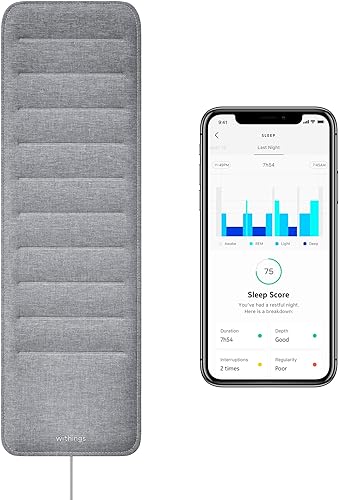 Click to zoom
Withings Sleep
~$130 typical, but price fluctuates ($113–$170 seen in 2026 depending on seller)
Some people will never wear a ring or a band to bed, and for them the Withings Sleep is the answer. It's a thin pad that slides under your mattress (rated for 10–45 cm thickness) and tracks sleep cycles, heart rate, snore detection, and a daily Sleep Score with nothing on your body and nothing to charge each night. It even exposes IFTTT and smart-home triggers on bed entry and exit, so it can dim the lights when you climb in.
Pricing is genuinely all over the place. It's typically around $130, but we've seen it listed anywhere from $113 to $170 across sellers in 2026, so check the current number before you buy rather than trusting any single quote — including ours. This is an older product line, and it shows: there are no daytime metrics, and per-night granularity sits below the top wearables. It measures the sleeper on that side of the bed, not you-the-individual walking around all day.
Buy it if the idea of wearing anything to sleep is a dealbreaker, or you want passive, zero-effort bedside tracking. Just don't expect it to rival Oura or WHOOP on the fine-grained overnight signals — that's not what it's for.
Check price on Amazon →Why "79% agreement" and "kappa 0.65" are the numbers that matter
When a tracker brags about accuracy, ask accuracy at what. There are two very different tasks hiding under the word "sleep."
Total sleep time is the easy one: did you sleep roughly seven hours, and when did you drift off and wake up? Almost every tracker in this guide nails this. Movement and heart-rate patterns make the sleep/wake boundary fairly obvious, so duration figures tend to be trustworthy across the board.
Four-stage classification — correctly labeling each chunk of the night as Wake, Light, Deep, or REM — is the hard one. A clinician does this from brain waves in a polysomnography (PSG) sleep study; a consumer device is inferring it from your pulse, temperature, and motion. That's why staging is where devices separate.
Two numbers cut through the noise. "Agreement with PSG" (e.g., Oura's ~79%) is the share of the night the device labeled the same stage the lab did. But raw agreement flatters a device, because some stages dominate the night — guess "Light" a lot and you'll be right often by luck. That's what Cohen's kappa corrects for: it measures agreement beyond what chance would produce, on a scale where 0 is coin-flip and 1.0 is perfect. In the Brigham and Women's study, Oura's kappa of 0.65 (moderate-to-substantial) beat Apple Watch's 0.60 and Fitbit's 0.55. Those gaps are small in absolute terms but meaningful — and they're the honest way to compare staging, precisely because kappa refuses to reward lucky guessing. So when you see a great total-sleep-time claim, remember: everyone hits that. The kappa is where the truth lives.
Sleep Tracker Comparison
| Tracker | Price | Ongoing cost | Form factor | Battery (rated) | Sleep-staging evidence (reported) | Screen |
|---|---|---|---|---|---|---|
| Oura Ring 4 #1 Best overall |
$349–$499 | $69.99/yr (12 mo incl.) | Ring | Up to 8 days | Best tested: kappa 0.65 vs PSG; ~79% agreement (own validation) | No |
| WHOOP 5.0 #2 Athletes |
Bundled w/ sub | $199–$359/yr | Band | Multi-day | With Oura as closest to lab-grade for overnight HR/HRV | No |
| Fitbit Charge 6 #3 Best value |
$159 (often <$100) | Optional $9.99/mo | Band | Up to 7 days | Trails leaders on staging (kappa 0.55); close on duration | Yes |
| Ultrahuman Ring Air #4 No-sub ring |
$349 | $0 (none) | Ring | Up to 6 days | Tracks staging; independent validation thinner than Oura | No |
| Withings Sleep #5 Bedside |
~$130 (fluctuates) | $0 (none) | Under-mattress pad | N/A (wired) | Cycles + snore + score; granularity below wearables | No |
Bottom Line
If you want the most trustworthy sleep staging and don't mind a subscription, buy the Oura Ring 4 — it's the most independently validated device here and the most comfortable to wear overnight. Serious athletes who think in terms of recovery should spend up for the WHOOP 5.0, accepting that the subscription never ends.
On a budget, or if you want a screen, GPS, and a nightly Sleep Score for under $100, the Fitbit Charge 6 is the easy call — just accept that its staging trails the leaders. Allergic to subscriptions? The Ultrahuman Ring Air gives you the ring experience at a lower lifetime cost, with the honest caveat that its validation record is thinner. And if you refuse to wear anything to bed, the Withings Sleep pad tracks you passively from under the mattress — check its price first, because it moves.
Every recommendation here is built on published independent testing and verified owner reports, not first-hand lab work we don't do. The numbers that separate these devices — the kappa scores, the PSG agreement figures — come from researchers, and we've tried to represent them straight.