Best Projectors of 2026: 5 Picks Actually Worth Buying
The Short Version
- Best overall value 4K: the Epson Home Cinema 2350 — bright, 4K PRO-UHD, with Android TV baked in. The all-rounder most people should buy.
- Best black levels under $800: the BenQ HT2060 — 1080p, but the contrast champ for a dark movie room.
- Best budget 4K & gaming: the ViewSonic PX701-4K — true 4K DLP with fast, high-refresh input for consoles.
- Best portable: the Anker Nebula Mars 3 Air — battery, Google TV, and licensed Netflix in a grab-and-go box.
Projectors are the rare corner of consumer tech where the marketing sheet and the wall rarely agree. Brands quote brightness in whatever unit flatters them most, "4K" can mean anything from a native panel to an aggressively pixel-shifted one, and the number that actually decides whether a movie looks good in your room — contrast — is often buried or omitted entirely. So we did the boring work: we cross-referenced published independent measurements against verified owner reports, and cut the field down to five machines that hold up across home theater, budget, and portable use in 2026.
None of these picks are the "cheapest 4K projector on Amazon." That category is a trap, and independent reviewers keep saying so. Below $700 or so, a good native 1080p projector with real contrast beats a bargain-bin 4K panel almost every time; the $700–$1,000 band is where 4K starts to actually earn its keep. Every recommendation here reflects that reality.
How We Evaluate Projectors
Let's be blunt about what Loiter Point is and isn't. We do not run a projector lab. We do not have a spectroradiometer, a light-sealed test room, or a stack of units on a bench. Anyone claiming otherwise on a review site with an affiliate link should make you suspicious.
What we do is synthesize. We pull the hard numbers — measured contrast, real-world brightness, input lag, color gamut coverage — from independent testing labs that actually own the equipment, primarily RTINGS-style measurement labs and ProjectorCentral. We then weigh those against verified owner reports for the things labs can't fully capture: fan noise over months, bulb dimming, real battery life, and how forgiving the auto-keystone is in a normal living room. Where a figure is a manufacturer claim, we label it rated. Where it's a lab or owner figure, we label it est. real-world or reported. We never call anything "measured" as if we measured it ourselves. And when the evidence is thin, we say so instead of inventing confidence.
One structural caveat we apply to every card below: brightness ratings are not comparable across brands. ANSI lumens, ISO lumens, and unqualified "lumens" are different measuring sticks, and vendors pick the one that reads highest. Treat every brightness number here as a rated claim for rough tiering, not a spec you can line up head-to-head.
 Click to zoom
Epson Home Cinema 2350
If you want one projector to handle movies, sports, and console gaming without a research project, this is it. The HC2350 uses Epson's 4K PRO-UHD pixel-shifting on a 3-chip 3LCD engine, and crucially it ships with Android TV built in — no dongle dangling off the back. It's bright, it's flexible, and it has vertical lens shift so you're not fighting your furniture to get a straight image.
Independent comparison from RTINGS lands it just behind our #2 pick overall, and it's worth understanding why: the BenQ edges it purely on contrast. In every other respect the Epson pulls ahead — it's brighter, it adds genuine 4K processing, and it bakes in streaming. For a room with any ambient light, that brightness advantage is the deciding factor.
| Resolution | 4K PRO-UHD (pixel-shift, 3LCD) |
| Brightness | 2,800 lumens rated |
| HDR | HDR10 / HLG |
| Smart platform | Built-in Android TV |
| Gaming | Low-latency mode |
| Extras | 10W speaker, Bluetooth, vertical lens shift |
| vs. #2 | Brighter + 4K + streaming; contrast trails BenQ reported |
 Click to zoom
BenQ HT2060
Here's the case for buying "only" 1080p in 2026. The HT2060 is an LED projector — no lamp to replace, ever — and per RTINGS' comparison it delivers noticeably better contrast than the pricier Epson. In a dark room, contrast is what makes a projected image look like a real picture rather than a washed-out slideshow. Black levels, shadow detail, that sense of depth: this is the projector for people who care about those things more than they care about a resolution number on the box.
It backs that up with wide color coverage (DCI-P3 and Rec.709), genuinely low 8.3ms input lag at 120Hz, vertical lens shift, 1.3x zoom, and 2D keystone for setup flexibility. It even supports 3D. The tradeoff is honest and simple: you give up 4K and built-in streaming to get the best black levels on this list at the lowest price. For a dedicated dark-room movie setup, that's a trade purists take every time.
| Resolution | 1080p (LED, no lamp) |
| Contrast | Best on this list reported |
| Color | DCI-P3 / Rec.709 wide gamut |
| Input lag | 8.3ms @ 120Hz |
| Optics | Vertical lens shift, 1.3x zoom, 2D keystone |
| Audio / extras | Dual 5W speakers, HDMI 2.0, 3D support |
 Click to zoom
XGIMI Horizon Ultra
This is the pick for people who want a 4K projector that behaves like a smart, self-adjusting appliance rather than a piece of A/V gear. The headline is Dolby Vision support, which is genuinely rare at this price, driven by a hybrid "dual light" laser/LED engine. But the everyday magic is Intelligent Screen Adaption: point it roughly at a wall and it auto-focuses, auto-keystones, and even compensates for wall color. The 2x12W Harman Kardon speakers mean it can run without a soundbar in a pinch.
It runs Android TV 11, supports Active 3D, and scales up to a 200-inch image. As an LED/laser design it also sidesteps lamp replacement entirely. It costs meaningfully more than the rest of this list, and its rated 2,300 ISO lumens is a different measuring stick than the others quote — but if convenience, Dolby Vision, and a clean living-room install matter more than squeezing the last dollar of value, it's the one to get.
| Resolution | 4K with Dolby Vision |
| Brightness | 2,300 ISO lumens rated |
| Light source | Dual light (hybrid laser/LED) |
| Setup | Intelligent Screen Adaption (auto keystone/focus/wall-color) |
| Audio | 2x 12W Harman Kardon |
| Platform / extras | Android TV 11, Active 3D, up to 200" |
 Click to zoom
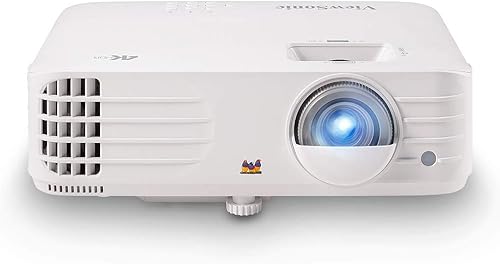
ViewSonic PX701-4K
Widely cited by independent reviewers as the best budget 4K projector heading into 2026, and it earns that on two fronts. First, it's a true 4K DLP panel — not just pixel-shifted 1080p — with a rated 3,200 lumens that handles rooms with some light. Second, it's a legitimately good gaming projector: it supports up to 240Hz and posts roughly 4.2ms input lag at 1080p, which is console-shooter territory.
Setup is friendly for the price, with auto vertical keystone plus manual horizontal/vertical keystone, 1.1x optical zoom, and dual HDMI inputs. The one asterisk is the light engine: this is a lamp-based projector, so factor in an eventual bulb replacement as a running cost that the LED and laser picks on this list simply don't have. If you want real 4K and fast gaming for the least money, that tradeoff is easy to accept.
| Resolution | True 4K DLP |
| Brightness | 3,200 lumens rated |
| Gaming | Up to 240Hz, ~4.2ms input @ 1080p |
| Optics | 1.1x optical zoom, auto V-keystone + H/V keystone |
| Connectivity | Dual HDMI |
| Light source | Lamp-based — plan for bulb replacement |
 Click to zoom
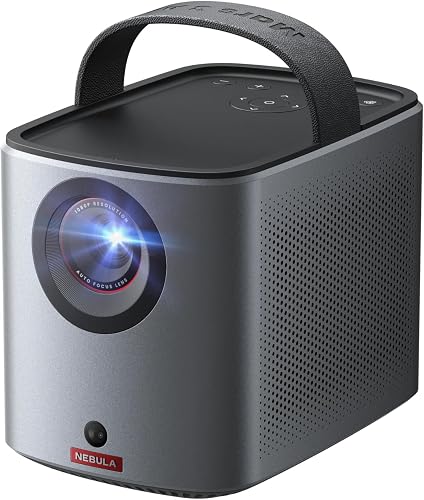
Anker Nebula Mars 3 Air
The Mars 3 Air is the pick when the projector needs to move — backyard, camping, a friend's blank wall. It has a built-in battery good for a reported ~2.5 hours of video, native 1080p, Google TV, and — importantly — officially licensed Netflix, which is the app that trips up most portable projectors. It throws up to a 150-inch image and has Dolby Digital sound onboard.
Set expectations on brightness: 400 ANSI lumens rated is fine after dark or in a dim room, and it is not trying to fight daylight — no battery-powered projector at this size does. What makes it a standout in 2026 is price movement: deal-tracker reports have repeatedly pulled it down to the $420–$470 range from its $599.99 list. At that price, a genuinely portable 1080p projector with real streaming apps is an easy call.
| Resolution | Native 1080p |
| Brightness | 400 ANSI lumens rated |
| Battery | ~2.5h video reported |
| Platform | Google TV + licensed Netflix |
| Audio / image | Dolby Digital, up to 150" |
| Street price | $420–$470 on discount reported |
Lamp vs. LED vs. laser — and why "lumens" lie
Two spec traps decide a lot here. The first is the light source. Lamp-based projectors like the ViewSonic PX701-4K are usually cheaper up front but the bulb dims over time and eventually needs replacing — a real running cost. LED (BenQ HT2060) and laser or hybrid laser/LED (XGIMI Horizon Ultra) light engines are effectively maintenance-free for the life of the projector; there's no bulb to buy. That difference doesn't show up on the sticker price, but it shows up in your wallet a few thousand hours later.
The second trap is brightness units. "Lumens," "ANSI lumens," and "ISO lumens" are measured differently, and every brand quotes whichever reads highest. The Epson's 2,800 and ViewSonic's 3,200 aren't directly comparable to the XGIMI's 2,300 ISO lumens or the Nebula's 400 ANSI lumens. Use these numbers to sort projectors into rough brightness tiers — daylight-capable, dim-room, dark-room-only — and ignore anyone who lines them up to two decimal places as if they were.
The 5 Picks, Side by Side
| Projector | Best for | Resolution | Brightness (rated) | Light source | Price |
|---|---|---|---|---|---|
| Epson HC2350 | Overall value 4K | 4K PRO-UHD (shift) | 2,800 lm | 3LCD lamp | ~$800–$1,000 |
| BenQ HT2060 | Contrast under $800 | 1080p | — (LED) | LED | ~$700 |
| XGIMI Horizon Ultra | Premium lifestyle | 4K + Dolby Vision | 2,300 ISO lm | Hybrid laser/LED | ~$1,500–$1,700 |
| ViewSonic PX701-4K | Budget 4K / gaming | True 4K DLP | 3,200 lm | Lamp | ~$700–$900 |
| Nebula Mars 3 Air | Portable | 1080p | 400 ANSI lm | LED (battery) | ~$420–$600 |
Brightness figures are manufacturer-rated and use different measuring standards across brands; treat them as tiers, not head-to-head specs.
Bottom Line
Most people should buy the Epson Home Cinema 2350: it's the balanced 4K all-rounder with brightness and built-in streaming to spare. If your room is dark and you care about black levels above all, the BenQ HT2060 gives you the best contrast here for less money — and no bulb to ever replace. Console gamers and value hunters who want genuine 4K should look at the ViewSonic PX701-4K, the XGIMI Horizon Ultra is the premium, self-installing Dolby Vision splurge, and the Anker Nebula Mars 3 Air is the go-anywhere portable, especially when it dips toward $420.
Want to go further? If your budget stretches well past this mainstream range and you're chasing outright best-in-class home-theater image quality, independent labs currently rate the enthusiast-priced Valerion VisionMaster Max as the top overall pick — that's the step-up path beyond this list.