Best Bluetooth Trackers of 2026
Lost keys, a bag that walked off at the airport, a cat that treats the neighbor's shed as a second home. A good Bluetooth tracker turns all of that from a panic into a glance at your phone. But the tracker matters far less than the network behind it, and that is where most buying guides quietly mislead you. Below is our evidence-first pick list, built entirely from published independent measurements and verified owner reports, not from a lab we don't have.
The Short Version
- iPhone owner? Get the Apple AirTag 2. The new U2 chip and the roughly billion-device Find My network make it the strongest tracker for actually recovering something out of range.
- Android owner who hates dead batteries? The Pebblebee Clip 5 is rechargeable, loud, and rides Google Find Hub.
- Want the loudest ring? The Chipolo Loop is among the loudest trackers in independent testing.
- On a budget or all-in on Samsung? The Chipolo Pop and the Samsung Galaxy SmartTag2 cover those cases cheaply.
How We Evaluate Bluetooth Trackers
Loiter Point does not operate a lab, and we do not test products ourselves. Instead, we synthesize the published measurements of outlets that do run controlled tests — CNN Underscored, Engadget, Tom's Guide, Android Authority and Android Central — and cross-check those against verified owner reports for the long-tail stuff labs rarely capture, like battery life a year in.
When we cite a real-world figure — loudness in decibels, effective range in feet, months of battery — it comes from one of those independent sources or from aggregated owner reports, and we label it as such. Spec-sheet numbers from manufacturers are labeled as claims. Where credible sources disagree, we show you the spread rather than pick a convenient number.
We weight four things: crowd-find network size (the single biggest predictor of whether you get your stuff back), find precision (ultra-wideband vs. plain Bluetooth), loudness and battery, and platform fit. That order is deliberate. As you'll see, a mediocre tracker on a huge network beats a brilliant one on a tiny one.
The Five Picks
 Click to zoom
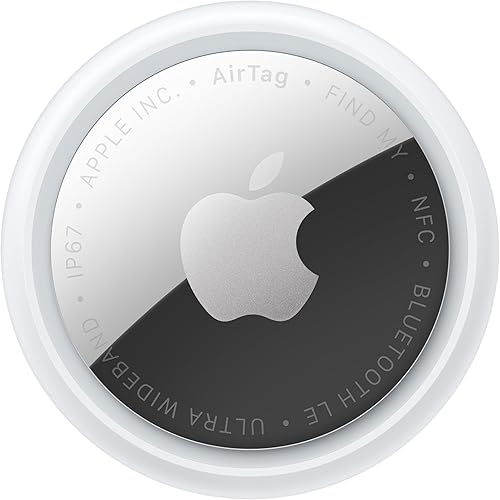
Apple AirTag 2
$29Best overall for iPhone
The second-generation AirTag, released in January 2026, is the easy default for anyone in the Apple ecosystem — and it earns it. The headline upgrade is the new U2 ultra-wideband chip. Where the original AirTag's Precision Finding kicked in at roughly 15 meters, reports on the gen-2 put it working from up to around 60 meters, roughly 1.5x further, so you're pointed straight at your keys from across a parking lot instead of a room. Apple also made the speaker up to 50% louder than gen 1, addressing the most common complaint about the first model.
But the real moat is the Find My network. Independent tests consistently rate it strongest for out-of-range recovery, and it's simply the largest crowd-find network in the world — on the order of a billion Apple devices silently relaying location for anything lost. In 2026 independent testing of trafficked areas, AirTags were among the fastest to surface a lost item, near-real-time. Precision Finding now also works from an Apple Watch Series 9 and later or Ultra 2 and later, so you don't even need to pull out your phone.
The honest caveats: it's iPhone/iPad only (Android users, skip to #2), it uses a non-rechargeable CR2032 that lasts about a year, and there's no keyring hole, so budget a few dollars for a holder.
 Click to zoom
Pebblebee Clip 5
$35Best for Android / best rechargeable
If AirTag is the answer for iPhone, the Pebblebee Clip 5 is the thinking Android owner's pick. It works with Google Find Hub, which in 2026 independent testing has improved dramatically — trackers on Find Hub were among the fastest to locate lost items in trafficked areas, essentially neck-and-neck with AirTags on Apple's network.
The Clip 5's standout is its rechargeable battery. Pebblebee rates it around 12 months per charge, and independent coverage confirms it lasts roughly double the ~6 months you get from a Chipolo before you're digging for a charging cable. It also has a built-in keyring loop, an LED strobe to help you spot it in the dark, and a loud siren (Pebblebee claims up to 130 dB — treat that as a manufacturer figure, not a measured one). Reported Bluetooth range is about 500 ft, a bit further than Chipolo's ~400 ft.
One important limitation: the Clip 5 works with either Apple Find My or Google Find Hub, and you choose which at setup. Pick the one that matches your phone and don't expect to switch freely later.
Chipolo Loop
$39Loudest
If your losses happen inside the house — the remote in the couch, keys under a coat — loudness matters more than crowd networks, and the Chipolo Loop is built for exactly that. It is one of the loudest trackers in independent testing, though sources disagree on precisely how loud.
Evidence note: CNN Underscored reports the Loop at around 112 dB, while another independent test measured roughly 105 dB. Either way it lands among the loudest trackers tested; we'd trust the ~105–112 dB range over any single number.
Beyond volume, the Loop is rechargeable (about 6 months per charge — solid, though half the Pebblebee's), has a sturdy fabric loop for attaching to bags, and like the Pebblebee works with either Apple Find My or Google Find Hub, selectable at setup. Range is about 400 ft, typical for the category. It's a bit pricier than our budget pick, and you're paying largely for that siren and build quality.
Chipolo Pop
$29Best budget
The Chipolo Pop is the value play: the same network flexibility as its pricier sibling — Apple Find My or Google Find Hub, selectable at setup — at the lowest Chipolo price. The key difference from the Loop is a user-replaceable battery instead of a rechargeable one, which some owners actually prefer: no charging ritual, just swap a coin cell when it dies.
You give up a little loudness and the premium loop, but for tagging a spare set of keys, a backpack, or a kid's water bottle, the Pop does the job for well under thirty dollars. If you're buying three or four tags to blanket the house, this is where the math works.
Samsung Galaxy SmartTag2
$29.99Best for Samsung
If you carry a Galaxy phone, the SmartTag2 slots into Samsung's SmartThings Find network and just works — deep OS integration, UWB precision finding on supported models, and an IP67 rating. It's also the value story of the bunch: it lists at $29.99 but is frequently discounted to around $18–20, making it one of the cheapest capable trackers you can buy.
The hard limitation is the reason it's #5 rather than higher: it's Samsung Galaxy phones only. Not Android broadly — Samsung specifically. If you own a Pixel or a non-Samsung Android phone, this isn't for you; the Pebblebee Clip 5 or a Chipolo on Google Find Hub is your Android answer. But for a committed Galaxy household, nothing else is this seamless or this cheap on sale.
Nerd box: why crowd-network size beats every spec
People shop for trackers by comparing decibels and feet of range. Those numbers matter only when the item is near you. The moment your bag is three miles away in a taxi, Bluetooth range is irrelevant — what finds it is other people's phones.
Every modern tracker piggybacks on a crowd-find network: when any stranger's phone running the same network passes near your lost tag, it silently, anonymously reports the tag's location back to you. So the network's density is the whole game. Apple's Find My spans roughly a billion devices; Google Find Hub taps the enormous Android install base and, per 2026 independent testing, has closed most of the gap. Samsung's SmartThings Find is capable but limited to Galaxy phones, and Tile's opt-in community network is far smaller than either. That's why a $29 AirTag on a billion-device network recovers a lost item that a technically superb tracker on a sparse network never will. Buy the network first, the tracker second.
Nerd box: UWB precision finding vs. Bluetooth ring-and-hope
Plain Bluetooth trackers can only tell you two things once you're close: roughly how strong the signal is, and how loud they can beep. That's "ring and hope" — you play the sound and rummage around following your ears.
Ultra-wideband (UWB), the tech in the AirTag 2's U2 chip and supported Galaxy SmartTags, is different in kind. It measures the actual time a radio pulse takes to travel between your phone and the tag, which yields distance to within centimeters and, with multiple antennas, direction too. That's why AirTag's Precision Finding can literally put an on-screen arrow and a distance readout on your phone — "keys, 12 feet, that way." On the gen-2 AirTag, reports say that experience now kicks in from up to around 60 meters instead of ~15. If you frequently lose things in cluttered, close-range spots, UWB is the upgrade you'll actually feel.
Why no Tile Pro?
The Tile Pro (now made by Life360) is a genuinely capable device on paper: 500 ft of range, a user-replaceable battery good for about a year, an IP68 rating, and true cross-platform support for both iOS and Android. On specs alone it would slot comfortably into this list.
Two evidence-based problems keep it off our pick cards. First, the network: per independent coverage, Tile's opt-in community network is far smaller than Apple's Find My or Google's Find Hub — and as the nerd box above explains, network density is the single most important factor in actually getting your stuff back. A tracker you love that can't find your bag across town isn't doing the job. Second, the money model: key features such as smart alerts sit behind a Life360 subscription of roughly $30 per year. Pay that annually and you've spent more than an AirTag every year for a weaker recovery network.
It's not a bad product, and cross-platform households with modest needs may still like it. But at these prices, the AirTag 2 (iPhone) and Pebblebee Clip 5 or a Chipolo on Find Hub (Android) simply give you a bigger safety net for less.
Full comparison
| Tracker | Price | Network | Range (reported) | Battery | Loudness | Platform |
|---|---|---|---|---|---|---|
| Apple AirTag 2 | $29 / $99 4-pack | Apple Find My (~1B) | UWB precision est. ~60 m | CR2032, ~1 yr | Up to 50% louder than gen 1 (reported) | iPhone / iPad |
| Pebblebee Clip 5 | $35 | Find My OR Find Hub | ~500 ft | ~12 mo rechargeable | Up to 130 dB (maker claim) | iOS or Android |
| Chipolo Loop | $39 | Find My OR Find Hub | ~400 ft | ~6 mo rechargeable | ~105–112 dB (indep. tests, sources vary) | iOS or Android |
| Chipolo Pop | $29 | Find My OR Find Hub | ~400 ft class | Replaceable coin cell | Loud (below Loop) | iOS or Android |
| Samsung SmartTag2 | $29.99 (~$18–20 on sale) | SmartThings Find | Not independently verified | Replaceable coin cell | Loud (owner reports) | Samsung Galaxy only |
| Tile Pro (not a pick) | $34.99 (+ ~$30/yr for some features) | Tile community (smaller) | ~500 ft | Replaceable, ~1 yr | Loud | iOS & Android |
Bottom Line
Buy for the network, then the features. If you carry an iPhone, the Apple AirTag 2 is the pick, full stop — the U2 chip sharpens close-range finding and the billion-device Find My network makes long-range recovery a near-certainty. On Android, the rechargeable Pebblebee Clip 5 on Google Find Hub is the best all-rounder, with the Chipolo Loop for anyone who prizes a loud siren and the Chipolo Pop when price is the priority. All-Samsung household? The frequently-discounted Galaxy SmartTag2 is the seamless, cheap choice. Match the tracker to your phone and you'll rarely lose anything for long again.